



On October 7, 2025, the US government paid $35.6 million for a 10% share of a small mining company based in Vancouver (British Columbia) called Trilogy Metals. The stock jumped more than 200 percent that day.
John Paulson, a billionaire Trump donor once floated as a nominee for Treasury Secretary, owned about 8.7% of the company. (For context, Paulson is estimated to have bundled more than $50 million in donations for Trump.) Thanks to the Trilogy Metals investment, Forbes reported that his shares went from roughly $30 million to roughly $100 million in a single trading session. A senior White House economic adviser who also held shares saw a gain of about $70 million, according to Rep. Jared Huffman (D-CA).
All of this happened without a single vote, public regulation, or public comment. A deal was announced and a lot of money moved, quickly.
But the investment in Trilogy Metals is not unusual. Rather, it is an entry on an ever-growing list of companies that the US now owns.
On Equity
An “equity stake” just means ownership. If the government buys 10% of a company, it owns 10% of the company, the same as any other shareholder.
The Cato Institute, a libertarian think tank, has been keeping count. By the end of July 2026, the federal government’s ownership portfolio had grown from zero to 30 companies. Fortune put the total at about $26.7 billion of your tax dollars being invested in these private businesses. The list includes Intel, MP Materials, Lithium Americas, Westinghouse, L3Harris, and a string of rare earth and semiconductor firms most people have never heard of.
There is also U.S. Steel, where the government holds a so-called “golden share,” or a single share that carries a veto. In other words, a golden share lets the president block company decisions he does not like.
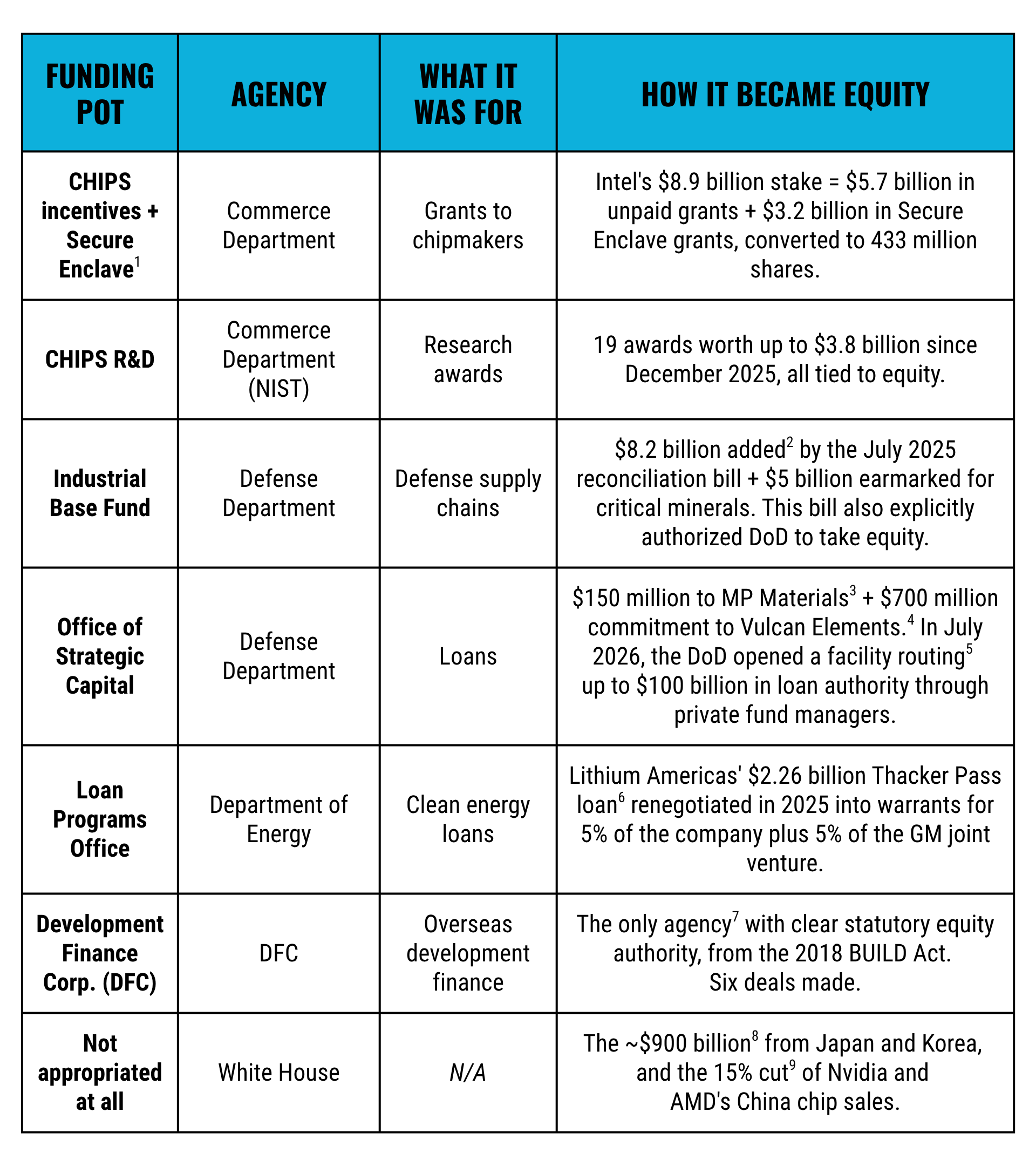
It helps to ask where the money comes from. For most of the equity stakes, Congress did not vote to spend on stock. Rather, Congress voted for grants, but those became stock. The $8.9 billion Intel stake was assembled out of $5.7 billion in CHIPS grants that Intel had been awarded but not yet been disbursed, plus $3.2 billion from a separate Pentagon chip program. In another case, the Energy Department’s Thacker Pass loan to Lithium Americas was renegotiated in 2025 so that the government took warrants instead. (See the table below for details.)
In other words: Congress voted for subsidies and got equity stakes.
Where Congress did act, it acted late. The July 2025 reconciliation bill put $8.2 billion into the Pentagon’s Industrial Base Fund and authorized the department to take equity through it. That came months after the deals had already started.
The next round of purchases will be bigger and harder to see. In July 2026, the Pentagon’s Office of Strategic Capital opened a facility that routes up to $100 billion in loan authority through private fund managers, who blend it with their own money before investing. That is more than every announced deal combined, which will moving through a layer of funding that creates more distance between these decisions and public scrutiny.
Tad DeHaven, a policy analyst at the Cato Institute, noted that the Biden administration handed out money from the same CHIPS Act pot without taking ownership in return.
Table 1. Where the Money for Equity Stakes is Coming From
Understanding the Risks
There are four things you should know about these ownership stakes. First, their legality is dubious. Second, they create all kinds of conflicts of interest between individuals and companies, as well as between regulators and companies. Third, this looks a lot like the early stages of kleptocracy, where governments get more and more involved in choosing favorites through private negotiation, rather than allowing open competition in markets. Finally, this is part of a broader pattern, where the US government is getting more involved in the market, all the while touting “deregulation” and skirting public accountability.
Let’s take them one by one.
1 | The Legal Ground is Thin, But Some People are Getting Rich
There has been bipartisan support for some acquisitions and both presidential candidates in 2024 supported the creation of a sovereign wealth fund, which would invest in companies. But this kind of buying can create all kinds of problems if it not well-managed or governed transparently.
Another issue is how the administration is justifying these purchases. The CHIPS Act lets the Commerce Department give out grants and sign agreements, but it does not say the department can buy stock. For the mining and defense deals, the administration has reached for the Defense Production Act, a Korean War-era law meant for emergency purchases. (For details, we recommend checking out this article from Lawfare, which walks through how much weight these authorities are being asked to carry.)
There is also no single public ledger of what the government owns. The holdings sit across at least four agencies. The most complete accounting is a tracker kept by the Council on Foreign Relations, a private think tank, because the government does not publish one. Additionally, federal budget rules count stock purchases as money out the door and barely track what comes back. So in the case of Intel, the rise in stake price from $8.9 billion to $42 billion appears in no government budget document. And the Trilogy Metals windfall only surfaced because reporters and a minority-party congressman went looking, not because anyone had to disclose it.
Compare our current situation to what happened after the global financial crash in 2008. As part of the $700 billion bank bailout, Congress created a special inspector general, quarterly reports, an oversight panel, and standing audits. Even then, its own watchdog still told Congress that taxpayers were not being told enough. Today’s portfolio has none of that machinery for accountability.
It gets worse. The Trump family may be directly profiting.
Ethics filings released in May 2026 show an account held in the president’s name accumulated Intel shares through March, six months after his administration’s stake sent the price up. On April 30, Trump posted on Truth Social that “Intel stock continues to rise.” The shares gained 3 percent during after-market hours trading. The government owns roughly a tenth of the company. According to the Fortune, the same account made 3,642 trades in the first quarter alone.
Asked who directs it, the Trump Organization says outside institutions hold “sole and exclusive authority over all investment decisions.” The White House says the assets are in a trust managed by his children. Eric Trump says it is a blind trust holding index funds. Those are three different answers.
Richard Painter, chief White House ethics counsel under George W. Bush, told Fortune he had checked the record: “I don’t think we’ve had any president trade in the stock market.” Since 1963, presidents have used blind trusts, index funds, and Treasuries, or, in Jimmy Carter’s case, sold the peanut farm. Painter added that the filing covers only the personal account, not the dozens of LLCs Trump controls. He said, “You’re looking at a very incomplete disclosure picture.”
You can judge for yourself just how much the president’s family should be able to directly profit from his decisions about individual companies.
2 | The Referee Bought a Team
What happens when those with the power to make decisions are also benefiting from them? The fight over Ambler Road, which we covered in a previous post, illustrates just how dangerous this can be.
The federal government decides whether the Ambler Road project in Alaska gets permitted. It also owns 10% of the company that would profit from that road being built.
The decision over whether or not to build this road has been fought over for a decade. Sixty-six tribal communities have a standing resolution against it. Federal reviewers found it would need more than 3,000 stream crossings and would cut the range of a caribou herd that has shrunk by two-thirds since 2003. The Department of the Interior rejected the project in 2024.
Yet this administration revived it, and now holds a financial stake in how it turns out. Whether you believe in building the mine or not, you should still be able to see the problem.
The pattern repeats in other cases:
The Pentagon owns 15% of MP Materials and guarantees it a floor price of $110 per kilogram for its rare earth output. If the market price drops, taxpayers cover the difference. The Pentagon also awards the contracts and sets the export rules.
Intel also warned in its own SEC filing that its non-US business “may be adversely impacted by the US government being a significant stockholder.”
When U.S. Steel tried to pause production at its Granite City plant in Illinois, the administration used its golden share to force the plant to keep making steel the company did not think it could sell.
The hypocrisy is plain. An administration that ran against government meddling now sets prices for private companies and vetoes decisions on the factory floor.
3 | This is How Early-Stage Kleptocracies Work
The comparison to Russia or Venezuela should be made carefully. The United States is not there. It still has courts, securities filings, a working press, and members of Congress who write oversight letters.
But decisions seem increasingly personalized, without clear decision-making rules or transparency. What seems like a gradual shift can suddenly turn into a full-blown kleptocracy.
Even in Russia, kleptocracy didn’t take hold overnight. Vladimir Putin did not seize the Russian economy in one move. He made an example of one company and one man: Yukos and Mikhail Khodorkovsky.
Khodorkovsky ran Yukos, Russia’s largest oil company, and was the richest person in the country. He funded opposition parties and criticized Kremlin corruption to Putin’s face at a televised meeting in early 2003. That October, security agents stormed his plane on a Siberian runway and arrested him. Yukos was then handed a tax bill of roughly $28 billion. To pay it, the company’s main production unit was auctioned to a shell company that The Washington Post could not identify. Within days, that shell company was absorbed by Rosneft, the state oil company. Khodorkovsky spent a decade in prison.
This example is illustrative. Russia’s Duma never passed a law to nationalize the oil industry. Existing tax law was applied, hard, to one person who had become politically inconvenient. Every other businessman in Russia drew the obvious conclusion. A 2008 law later put 42 industries under a rule requiring government approval for large foreign investment, but the point had already been made: staying in the president’s favor mattered more than anything.
Venezuela ran a cruder version. After the 2002-2003 strike, the government fired more than 18,000 of the state oil company’s 33,000 workers and filled the jobs with loyalists. Companies were seized. A class of politically connected businessmen, the boliburguesía, grew rich on contracts and currency access.
The common feature of both the Russian and Venezuelan systems is that a company’s fortunes stop depending on rules and start depending on a relationship with those in power.
The Intel deal is the clearest American example so far. In August 2025, Trump publicly called for Intel’s CEO, Lip-Bu Tan, to be fired. Tan went to the White House. Weeks later, the government held nearly 10% of Intel.
What are other CEOs learning from this example?
4 | This is Not the Deregulation You Were Promised
In January 2026, the scholar Alondra Nelson described the Trump administration’s sleight of hand on AI policy as a “mirage of deregulation.” What the administration says is deregulation is actually a “hyper-regulation by other means” that focuses on the president’s personal priorities rather than the public good. While Nelson focused on AI, the truth is that it fits with any of the other big-growth industries in the US right now.
The administration is as involved in the economy as any other administration, if not more. But it is also using legal mechanisms and channels that weaken Congressional oversight and public scrutiny, and that makes it both different and more dangerous.
Normal law is debated and amended on the floor of Congress and can be tracked online. You can call your congressperson if you are concerned. Normal regulation happens through administrative law. Administrative law requires agencies to propose rules, publish them, take public comments, and issue responses to them. Bigger yet, it can be sued if it ignores the evidence.
This process is slow. It is also the main way ordinary people and small firms get a say in decision-making and ensure that decisions are following the law.
The Trump administration’s equity stakes skip all of that regular process. And they are part of a bigger picture of this hyper-regulation without oversight:
Tariffs and export controls are set under emergency powers and carve-outs are handed to companies that ask nicely. This includes examples such as the deal letting Nvidia and AMD sell certain chips to China in exchange for giving the government 15% of the revenue.
AI vetting processes made by executive order are particularly vague. Because the Trump administration is not planning to make these processes public, it is unclear, “what level of scrutiny models will face and what safety benchmarks they must meet, leaving businesses, foreign governments and the public in the dark.”
Foreign investment promises, like the roughly $900 billion the administration says it secured from Japan and South Korea, will likely be steered into projects the president himself picks, outside the normal appropriations process.
Kevin Hassett, who runs the National Economic Council, called the Intel stake “a down payment on a sovereign wealth fund.” This could not be farther from the truth. A well-governed sovereign wealth fund, like the one Norway has, is created by law, with rules about what it can buy, who runs it, and what it must report. This one was assembled deal by deal, agency by agency. It has no rules at all.
What We Can All Agree On
If you believe government should not pick winners and losers, this is the thing you have been warning about for decades. But it is happening under a Republican president with a Republican Congress. Congress is even seeking to strengthen this practice: the Senate defense bill would give the Pentagon its own equity portfolio in statute.
DeHaven puts it plainly: Republicans warning that communists are taking over the Democratic Party “might first ask why their own administration is so eager to have the government acquire pieces of private companies.” Reason, a libertarian magazine, called it Republican socialism.
In the past, business interests have fought hard against government ownership. In 2022, when Senators Warren and Sanders proposed requiring the government to take equity in CHIPS grant recipients, the US Chamber of Commerce fought it, warning it would turn manufacturers into state-owned enterprises. They killed the amendment. Three years later, a Republican administration did it anyway, without any of the guardrails the original amendment carried.
If your concern is fairness, look at who is not getting the investment. Small startups aren’t getting money. Competing companies in each industry have to explain to their investors why the federal government didn’t choose them. The tribal communities that spent a decade filing comments on Ambler Road, through a process that at least required someone to answer them, are now facing a government that has financial incentive to ignore their claims. The taxpayer will absorb the costs of the new MP Materials price floor.
The only people who have done well for themselves are those who already held shares in these companies.
DeHaven calls this a Pandora’s box: a future administration of either party inherits every one of these tools. How will they use it and what favors will they call in when they need them?
Weekly Wins
Voters in Two States Refuse to Let Politicians Rig the Rules
Last Tuesday was a bad night for power grabs.
In Kansas, voters overwhelmingly rejected a GOP-backed amendment to replace judicial nominations with partisan elections for the state Supreme Court. The GOP plan was widely seen as an attempt to secure friendlier rulings on abortion and school funding. About 62% voted no.
In Missouri, voters blocked a Republican effort to make future constitutional amendments dramatically harder to pass. The proposal would have required citizen-led ballot measures to win a majority in every congressional district, rather than just statewide, on top of amendments already drawn by the legislature itself. The push came after Missourians used ballot measures to expand abortion rights, Medicaid, and the minimum wage.
Republicans wanted to change the rules after losing. Voters said no twice in the same night.
DC Circuit Court Tells Trump that the White House isn’t His
Trump wanted a $600 million ballroom. In response to a suit brought by the National Trust for Historic Preservation, a federal court just told him to stop building it. On Friday, a DC Circuit panel ruled 2-1 that the administration must get Congress's approval before continuing construction on the president's ballroom project. Congress, not the president, has "exclusive authority to regulate the construction and demolition of White House structures." Trump is vowing to appeal to the Supreme Court and is calling the ruling a national security threat.
Renewable Groups Win Lawsuit against the Pentagon
A coalition of civil society groups took the Pentagon to court, and it worked. Nine renewable energy organizations sued the Department of Defense in Oregon federal court, arguing the Pentagon had quietly frozen national security reviews for wind farms since August 2025, grinding to a full stop by this spring. The stakes were real: over $47 billion in investments and thousands of jobs across 21 states sat stuck in limbo. Last Thursday, Judge Karin Immergut, a Trump appointee, sided with the groups and issued a preliminary injunction ordering the Pentagon to resume reviews immediately. She didn't mince words, writing that the department "cannot pick and choose which parts of this legal regime to follow." The Pentagon must now report its progress to the court every 30 days while the case continues.
New Jersey Steps Up to Hold ICE Accountable
When the federal government won’t hold ICE accountable, states are stepping in. Last week, New Jersey Attorney General Jennifer Davenport opened a civil rights investigation into Delaney Hall, a Newark ICE detention facility, issuing formal subpoenas to the New Jersey Division on Civil Rights. The move follows reports of alarming conditions and at least three deaths at the facility. The most recent death was discovered only after a lawmaker’s unannounced oversight visit. Governor Mikie Sherrill backed the investigation, saying ICE and operator GEO Group have blocked health inspections and even stopped visitations. She’s been clear she wants Delaney Hall closed entirely. Davenport put it plainly: New Jersey has “both a legal and a moral duty to stand up for the civil rights of people within our state.”
This is what state power is for. When federal oversight fails and a private company answers to no one, a state attorney general can still open the door, issue subpoenas, and demand answers on behalf of the people in her state.
The Park Ranger Who Refused to Look Away
Melissa Dalley loved being a park ranger, but she quit her job rather than stay silent. After a Trump executive order and Secretarial Order 3431 forced the National Park Service to strip out exhibits on slavery, Indigenous massacres, and climate science, Dalley refused to go along with it. Instead of walking away, she got louder. She helped found America433+, a coalition named for the NPS's 433 sites, dedicated to preserving the history the government wants erased. All summer, she's driven from Yellowstone to Grand Teton to Glacier, standing in the empty spaces where signs used to hang and simply telling visitors what used to be there. At Grand Teton, she handed out printouts explaining a sign removed over the winter, about a 19th-century massacre of Blackfeet people. "If they don't want you to see the sign, I will show you the sign," she tells visitors.
More Links, More Kleptocracy
Build a Protection Racket
Bribes and influence peddling
A Marijuana Giant That Won Over Trump Has Found Enemies Closer to Home - NYT
Truth Social launches service selling faster access to Trump posts - NBC
FCC Commissioners Face Ethics Complaints for Taking Luxury Gifts From Paramount - ProPublica
Eric Trump backs $638M Space-Eyes, McKinley Acquisition merger - Manufacturing Dive
Lawmakers call for Pentagon probe of Trump family-backed companies - WaPo
Trump Crypto Took $100 Million From a Businessman With Red Flags - NYT
The Watchdogs Are Barking Themselves Hoarse - The Atlantic
Cronyism and favoritism
Trump Threatens to Revive $1.8 Billion Fund for Allies Over Blanche Standoff - NYT
Trump’s Fixation on Arctic Ships Led to Billions in No-Bid Contracts - NYT
The Trump administration wants $10 million more to cover its July Fourth celebrations - NPR
Private prisons announce $1.4 billion in revenue as immigration detentions climb - NPR
Retail gas stations touted by Trump racked up penalties in New Jersey - NOTUS
HHS awards small Texas firm with $150 million to represent unaccompanied children - NOTUS
Extorting the private sector
Decentralized violence and surveillance
Man detained at New Jersey immigration facility dies after ‘medical emergency’: ICE - ABC
ICE will release body camera video only when seen in the agency’s ‘best interests,’ policy says - AP
Get Rid of Independent Checks on Power
Executive power grabs
What Is the Trump Administration Doing With Foreign Aid Money? - ProPublica
Trump Says He’ll Appeal ‘Horrendous’ Ruling Against White House Ballroom To Supreme Court - Forbes
Centralizing executive authority
Federal workers sour on government work, decrying eroding job security - CBS
OPM preparing to take over federal employee appeals - Federal News Network
Trump overhaul could gut Head Start preschool standards, leaving states to set the rules - AP
US State Department to close consulates in Canada, Japan and Indonesia, sources say - Reuters
DOGE ‘Wall of Receipts’ padded figures, included baseless claims: watchdog - FedScoop
The ‘Zero’ People Who Died After USAID Was Dismantled- New Lines
Trump rejects his own DOJ’s finding blaming Reflecting Pool issues on shoddy renovation - CNN
Ripple effects: After Hearn, three others have their Reflecting Pool charges dropped - NPR
RFK Jr., Oz claim fraud crackdown drove ACA enrollment drop, but analysts cite rising costs - CBS
Trump installs Project 2025 author at Interior Dept watchdog - Public Domain
Targeting civil society and subnational government
25 states sue over Trump’s new tariffs, calling them ‘pretext’ to replace his old ones - AP
A federal judge lets DHS proceed with a border wall through a small Texas town’s levee system - AP
Pennsylvania School Leaders Fear ‘Catastrophic’ E-Rate Cuts - GovTech
Scientific integrity and academic freedom
Brown University’s president, who clashed with Trump over funding, steps down - Reuters
Trump administration asks colleges to commit to education overhaul - Politico
Trump’s EPA Is Using This Sneaky Tactic to Let Nasty Industries Foul Our Air - Mother Jones
Drive Division
Driving social division
Inside the Secretive Boards Deciding Trans Troops’ Fate - NYT
Inside school investigations frozen under Trump: Racial slurs, sexual harassment and more - WaPo
Control the Media and Suppress Free Speech
Censorship and retaliatory litigation
Justice Dept. Subpoenas Times Freelancer in Effort to Identify Sources - NYT
‘Vindictive motivations’: Don Lemon seeks to dismiss charges stemming from church protest - ABC
Data production, stewardship, and privacy
A Doctor Fact-Checks HHS Secretary Robert F. Kennedy Jr.’s CNN Interview - Forbes
RFK Jr. targets Fauci and pushes medical misinformation in fiery CNN interview - CNN
States sue to block feds from sharing personal data of millions who receive social service benefits - AP
Coordinate with Kleptocrats Abroad
New Round of Trump Threats and Pullbacks Raises Uncertainty in Mideast - NYT
How Donald Trump Made the World Safe for Kleptocrats - The National Review
Manipulate Elections
Maryland governor ‘very concerned’ Trump will interfere in midterms - ABC
Trump’s mail voting appeal tests Supreme Court’s anti-chaos election rule - CNN
Endnotes
1 https://newsroom.intel.com/corporate/2024-intel-news
7 https://www.cfr.org/articles/how-outdated-budget-rules-are-holding-back-american-industrial-policy
Trump controls the means of production.
The fuhrer is a commie