

Up in Smoke: How Donor Dollars Changed the FDA's Policy on Flavored Vapes
The latest kleptocratic actions by the Trump administration from the week of June 1, 2026


I don’t see how this solves for anything other than a gift to companies that are eligible and allowing illegal products to remain on the market because F.D.A. is going to look the other way.
- Mitch Zeller, former Director of the Center for Tobacco Products, Food and Drug Administration (FDA), quoted in The New York Times (May 10, 2026)
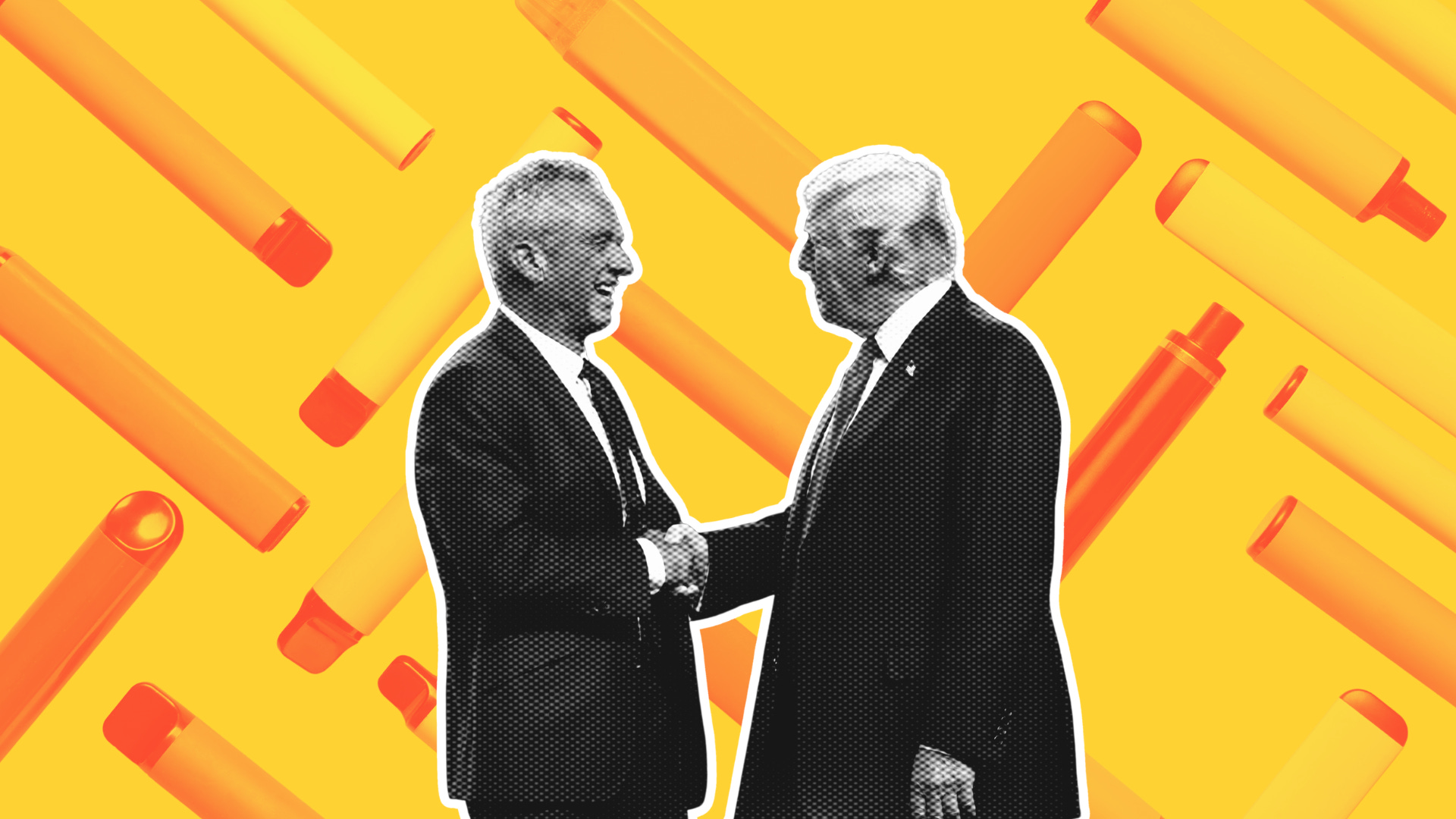
Kleptocracy doesn’t just siphon off public funds into private pockets. It’s worse than that. Self-dealing drives policy decisions that cause real harm for all of us, especially the most vulnerable.
In this week’s post, we dig into the latest example: how two tobacco companies have used donations to Trump to push for a favorable policy change on flavored vapes at the FDA, and the risks it poses to our children.
Why Flavored Vapes Put Children and Teens at Risk
Tobacco use is the leading cause of preventable disease and death in the United States, killing more than 480,000 people every year. Though many companies market e-cigarettes as a smoking cessation tool, the Centers for Disease Control and Prevention (CDC) warns that they are not safe for youth, young adults, pregnant women or adults who do not already use tobacco. The CDC specifically warns that e-cigarette aerosols can harm the lungs and that nicotine exposure can impair brain development through about age 25. Nicotine addiction from vaping is also associated with a higher risk that young people will go on to smoke conventional cigarettes.
As a refresher, the concern about vaping peaked in 2019, when the rates of use among teens surged: about 10.5% of middle school and 27.5% of high school students reported using e-cigarettes at that time. In 2021, 70% of middle and high school students reported exposure to e-cigarette marketing. Another study found that 90% of students who vaped preferred flavored products.
In February 2020, the FDA restricted the sale of all unauthorized flavored e-cigarettes other than tobacco and menthol flavors, an approach that the Supreme Court upheld unanimously. These restrictions, combined with public information campaigns, helped lower teenage vaping rates significantly to just 8% of high school students and 3.5% of middle school students. By 2024, the director of the FDA’s tobacco division, Brian King, could say, “I want to be unequivocally clear that this continued decline in e-cigarette use among our nation’s youth is a monumental public health win.”
Yet under the Trump administration, such policy wins can be quickly undone for the right price. Let’s explore how.
How the FDA Policy Changed
Long-term efforts to protect the health of American youth can be erased in just a week. The following events last month illustrate how quickly the Trump administration pivoted on the flavored vape policy after the president had lunch with donors.
April 30: Reynolds American, one of the largest tobacco companies in the US, donated $5 million to MAGA Inc., a political action committee (PAC) backed by President Trump. This amount was on top of a $10 million donation by the company to a separate super PAC backing Trump’s campaign, as well as a contribution to the White House ballroom.
May 2: According to The New York Times, executives from Reynolds and Altria (the maker of Marlboros with investments in vapes) had lunch with the president at his golf resort in Jupiter, Florida. During the lunch, Trump reportedly called Robert F. Kennedy Jr., the Secretary for Health and Human Services, and Dr. Mehmet Oz, the head of the Centers for Medicare and Medicaid Services, to complain about the FDA’s regulation of e-cigarettes. During the same weekend, Trump also called FDA Commissioner Marty Makary to “upbraid” him for moving too slowly on the approval of flavored vapes.
May 5: FDA issued new guidance that opens the door for major tobacco companies to begin selling flavored vapes. Makary resigned a few days later, following a well-documented “pressure campaign.”
Here’s an excellent overview from the folks over at @firedbutfighting and @nationalphc, who collaborated with us to amplify this story.
FDA staffers reported that they were “blindsided” by the new guidance, noting that the decision violated the rulemaking process by:
bypassing the federally required period that allows for public comment and revisions;
lacking the necessary scientific verification of health benefits for smokers before any new products are introduced; and
circumventing the staff consultation process.
Health advocates have sharply criticized the policy shift. The American Academy of Pediatrics urged the government to reconsider the authorization, calling it “a concerning precedent [that leaves] pediatricians deeply alarmed that these products will end up in the hands of young people.” Similarly, the American Lung Association condemned the decision, noting that it was “deeply troubling to see FDA ignore the scientific evidence and reverse course.”
As former director of the Center for Tobacco Products Mitch Zeller put it, “It begs the question of whether the true subject matter experts may have actually opposed this policy and were ordered to do it anyway. And that goes to the ability of the public to have trust and faith in institutions like FDA.”
Pay-to-Play as Public Policy
It may not be incidental that another potential beneficiary of the new vaping guidance is klepto-baby Donald Trump, Jr. The president’s son was named a partner in 1789 Capital just days after the election of his father in 2024. 1789 Capital is an investor in e-cigarette maker Juul, the company that played a leading role in the youth vaping epidemic.
We expect our elected leaders to put the public interest above their own self‑interest. Donald Trump and Robert F. Kennedy Jr. campaigned on a platform to Make America Healthy Again, yet the policies they have adopted over the last 18 months track closely with the priorities of their donors. Trading away the health of American teenagers to please the tobacco industry is the opposite of making America healthy again. But it is entirely consistent with the assaults we have seen on our environment, federal workers, and public lands.
Under a kleptocracy, public health, like so many of our public goods and services, goes up in smoke.
Weekly Wins
Trump’s Culture Grab Hits a Wall
There have been some clear wins this week for the idea that American culture is not just another Trump-branded asset. For one, a federal judge ordered that Trump’s name be erased from the Kennedy Center for the Performing Arts and that officials pause plans to close the venue for two years, finding that only Congress can change the Center’s name.
In the same 48‑hour span, the Trump‑backed “Freedom 250” concert series began to implode, as seven out of the nine featured musical acts pulled out rather than lend their names to a presidential vanity project. Trump responded that he is “thinking about” canceling all of the performances and replacing the show with a rally featuring...himself. Taken together, these decisions underscore that there are limits to how far a president can impose himself on the nation’s shared civic and cultural treasures.
GOP State Senators Help Sink Trump's Gerrymander in South Carolina
We also saw an unexpected win over Trump’s desire for a deeply gerrymandered map to disenfranchise Black voters. The mid‑decade redistricting push, which was designed to erase Rep. Jim Clyburn’s majority‑Black district and hand Republicans another House seat, collapsed in the GOP‑controlled state Senate after 12 Republicans joined Democrats to block the plan. Early voting for the June primary was already underway and the failed proposal would have tossed out ballots already cast and forced an August do‑over election under new lines. Senators balked at rewriting the rules midstream, despite personal pressure from Trump and a special session called by Gov. Henry McMaster. For now, Clyburn’s district—and the basic idea that you shouldn’t redraw the map in the middle of the game just because the president wants another seat—remains intact.
Legal Roadblock for Trump’s "Anti-Weaponization" Fund
US District Judge Leonie Brinkema temporarily froze the Justice Department’s $1.8 billion dollar “anti‑weaponization” fund, an initiative critics warned would operate as a slush fund to reward the president’s allies. Brinkema’s order ensures, for now, that no funds are "irreversibly disbursed" while a coalition that includes a former January 6 prosecutor challenges the scheme in court, with an expedited hearing set for June 12. It’s only a temporary pause, but it’s a clear signal that at least one federal judge is not prepared to let Trump use public money as a patronage pool without serious legal scrutiny.
More Links, More Kleptocracy
Build a Protection Racket
Bribes and influence peddling
Trump promotes unregulated online casino after $1 million Super PAC donation - Popular Information
US regulator withdraws $5 million penalty against Winklevoss crypto exchange - Reuters
Trump bought stock in UFC’s parent company as he promoted White House fight - Huff Post
Trump stock trades prompt charges of corruption and profiting off of the presidency - PBS News
Cronyism and favoritism
Eric Trump invested in drone maker shortly before war - Snopes
Dell stock soars on Data-Center revenue and Pentagon deal - WSJ
Company led by Republican fundraiser pardoned by Trump wins $106m federal contract - The Guardian
‘Nobody cared and I’m allowed to’ - Trump’s guide to self-dealing - Washington Examiner
The White House intervened to get a $620 million deal for a company tied to Don Jr - ProPublica
Japanese megacorp SoftBank donates $50 million to Trump library - Politico
Decentralized violence and surveillance
The White House’s Aliens.Gov site brags that ICE arrested more than 700 US citizens - Wired
An ICE firearms trainer was involved in at least 4 deadly shootings - Wired
Palestinian woman detained for a year after protesting war in Gaza - PBS News
Get Rid of Independent Checks on Power
Executive power grabs
Centralizing executive authority
Justice Dept launches criminal investigation into Trump accuser Jean E. Carroll - CNN
Pentagon is recruiting troops to watch the UFC fights - WaPo
Trump’s signature on $100 bill to put him in small circle of sitting presidents - Reuters
Trump is the only person who can save America, according to his cabinet - NYT
Trump administration sees striking exodus of legal talent - NYT
Here are the adversaries Trump has threatened and prosecuted - WSJ
Targeting civil society and subnational government
Fears of travel chaos flare as Mullins considers pulling customs officers from Newark Airport - Politico
Trump’s DoJ sues four Democratic states over denying undercover license plates for federal agents - PBS News
Sherrill blocked from ICE facility as detainees enter Day 4 of hunger strike - NOTUS
Scientific integrity and academic freedom
Trump admin cutting key researchers out of global virus response talks - CNN
Trump lifts restrictions on off-road vehicles on public lands - NYT
White House seeks to tighten political control of grantmaking - Science
How Replimune’s drug got a third chance after White House intervention - WSJ
Drive Division
Driving social division
The State Department really doesn’t want to talk about the Office of Remigration - Wired
How the Trump Administration uses the Bible to justify military invasions and immigration raids - NPR
Control the Media and Suppress Free Speech
Censorship and retaliatory litigation
Manipulate Elections
 | A guest post by
|